Tamara de Lempicka

Image courtesy of: http://www.decasandiego.com
(1898-1980)
“I live life in the margins of society, and the rules of normal society don't apply to those who live on the fringe.”

Auto-Portrait (Tamara In The Green Bugatti) ~ 1925
Book-ended by the two Great Wars and attaining its zenith during the decades of the 1920s and 1930s, the symmetrical, rectilinear style known as "Arts Decoratifs" (which derived its name from a 1925 exhibition held in Paris: Exposition Internationale des Arts Decoratifs et Industriels Modernes), was one of the pinnacles of the 20th Century's decorative styles and spanned the decades from 1910 to 1939. It was a truly international style; a style that swept across the globe. Influenced by Cubism, Futurism, Modernism and the Bauhaus art movements of the time, the clean geometric motifs, with their bold colours and the streamlined accents of Art Deco - as the shortened version of "Arts Decoratifs" style was commonly known - represented the ideal forms of that era. As the predominant decorative style of those years, Art Deco naturally touched absolutely every aspect of design - from common household items and interiors to textiles and the fine arts - and surfaced in a variety of ways: in literature, it was exemplified by F. Scot Fitzgerald's "flapper" novels (particularly The Great Gatsby), possibly the Age's most prominent author; in popular music, it was typified by the energetic tempo of American Jazz (the first truly all-American export) - accompanied by the quick-stepped Charleston - a youthful, frenzied and optimistic new rhythm that followed the devastation of the First World War and preceded the Second (in Paris, Jazz was personified by the American sensation, Josephine Baker, who "shimmied" her way to international acclaim and fortune); architecturally speaking, Art Deco reached its height - quite literally - in the first upward-thrusting skyscrapers, the marvels of engineering of the Age, epitomised by the gleaming Chrysler and the Empire State buildings of New York City - that great megalopolis, a vanguard and a bastion of modernity.
Nor were the oceans exempt from the style's grasp: nations on both sides of the Atlantic, such as England, France and America, for example, vied with one another and competed to set afloat the most luxurious liners to ever be launched on the waves (the French liners, the Île de France and the Normandie, foremost among them), with interiors of such beauty and craftsmanship that they rivalled those of the best, most exclusive hotels in the world. This dazzling era was also the age of great French furniture designers and cabinet-makers: Francis Jourdain, Émile-Jacques Ruhlmann, Jean Dunand, Le Corbusier, and André Leon Arbus - all of whom created pieces that lifted furniture - made of the finest and most exotic woods available - to the realm of art; in the process, these furniture-makers defined a new concept of luxury and taste. Likewise, even Haute Bijoutiers - fronted notably by such illustrious firms as Cartier, Boucheron, Chopard and Van Cleef & Arpels - reflected the attributes of the Art Deco style, with angular designs that creatively and unexpectedly mixed disparate materials and brightly-coloured stones (boldly juxtaposing traditional ones next to new; precious with semi-precious) in innovative and wholly modern ways. Artists, too, took up the era's linear style: Pablo Picasso, Georges Braque, Juan Gris and Marcel Duchamp all deconstructed and reduced established artistic traditions and processes to their bare, essential elements only to reconstruct them anew. The results may sometimes have been bizarre, but they were always energetic; the principles of art were redefined. Experimentation, dynamism, modernity, and novelty were the orders of the day.
Nor were the oceans exempt from the style's grasp: nations on both sides of the Atlantic, such as England, France and America, for example, vied with one another and competed to set afloat the most luxurious liners to ever be launched on the waves (the French liners, the Île de France and the Normandie, foremost among them), with interiors of such beauty and craftsmanship that they rivalled those of the best, most exclusive hotels in the world. This dazzling era was also the age of great French furniture designers and cabinet-makers: Francis Jourdain, Émile-Jacques Ruhlmann, Jean Dunand, Le Corbusier, and André Leon Arbus - all of whom created pieces that lifted furniture - made of the finest and most exotic woods available - to the realm of art; in the process, these furniture-makers defined a new concept of luxury and taste. Likewise, even Haute Bijoutiers - fronted notably by such illustrious firms as Cartier, Boucheron, Chopard and Van Cleef & Arpels - reflected the attributes of the Art Deco style, with angular designs that creatively and unexpectedly mixed disparate materials and brightly-coloured stones (boldly juxtaposing traditional ones next to new; precious with semi-precious) in innovative and wholly modern ways. Artists, too, took up the era's linear style: Pablo Picasso, Georges Braque, Juan Gris and Marcel Duchamp all deconstructed and reduced established artistic traditions and processes to their bare, essential elements only to reconstruct them anew. The results may sometimes have been bizarre, but they were always energetic; the principles of art were redefined. Experimentation, dynamism, modernity, and novelty were the orders of the day.

Image courtesy of: http://www.theywillnever.com
Although her reputation never reached the stature of a Braque or a Picasso, Tamara de Lempicka's work was - and remains to this day - highly sought after. There is a seductive element to her portraits - at times dark and sinister; at other times, enticing and glamorous, even mystical - and her subjects exude a worldly, blasé urbanity with something approaching debauched decadence. Lempicka's artwork, with its paper-thin crispness and her clean, sinuous lines (articulated with razor-sharp precision), has come to embody the Art Deco style in all its refined glory. It is precisely those unique elements of her work which still captivate art-lovers everywhere and distinguishes her work apart from any other of that period; her artwork (and the style of her work) is intimately identified with the exhilarating 1920s and 1930s - and has come to represent the quintessence of the high-living Jazz Age.

Image courtesy of: http://www.7emart.com
She was born Maria Gorska on May 16th, 1898, into a well-to-do family in Warsaw, Poland. Not much is known of her childhood aside from the fact that she had an older brother, named Stanczyk, as well as a younger sister, named Adrienne. Her parents, Boris and Lavina Gorska, were wealthy socialites. Boris Gorska was a lawyer and Lavina Gorska came from a moneyed family. The Gorskas provided their children with a life of luxury; it was a life that Maria would eventually come to believe to be her due.
Maria's first introduction to the world of Art came when she was twelve years old - her mother had her daughter's portrait painted by a famous painter. (Maria hated the finished painting for which she found it difficult to sit still and felt she could have accomplished a better result. To prove her point, Maria had her younger sister, Adrienne, sit while she painted her portrait. All that is known of the finished work is that Maria was pleased enough with the result to begin her life-long interest in art.) (Source: UXL Encyclopedia of World Biography, findarticles.com, 2003)

Image courtesy of: http://lnx.whipart.it
After her parents divorced in 1912, one of her relatives, an affluent grandmother, spoiled the young girl with trips abroad and beautiful clothes. She attended a school in Lausanne, Switzerland; however, at the age of thirteen, Maria decided that she was bored with school and frequently invented false illnesses for herself in order to stay home and avoid the boredom of the class-room. Instead of keeping her at home, her grandmother took her on a tour of Italy. The magnificence and rich history of Italian art and architecture intensified Maria's love of art. Upon her return home, Maria was confronted with the news that her mother, Lavina Gorska, had decided to remarry in spite of her daughter's protestations to the otherwise. Unhappy with her mother's decision and in an act of rebellion, the fourteen-year-old Maria spent her school vacations with her Aunt Stephanie in St. Petersburg, Russia - then at its height of sophistication but also at the dusk of its Tsarist splendour. Her Aunt Stephanie lived prosperously: her millionaire banker husband had their St. Petersburg home decorated by the famous French firm of Maison Jansen. The luxury and splendid lifestyle in which her Aunt Stephanie lived made quite the impression on the young girl, imprinting on her a standard by which she aspired to live in the future; it was a standard from which she never swerved. (Sources: delempicka.org, 2011; UXL Encyclopedia of World Biography, findarticles.com, 2003)

Portrait Of A Man (Taduesz Lempicki) ~ 1928
Image courtesy of: http://thepaintedwoman.blogspot.com
Image courtesy of: http://thepaintedwoman.blogspot.com
The outbreak of World War I changed everything: relations between Russia and Germany turned hostile and both nations declared war on one another; the world, as Maria knew it, came to an abrupt end. Still, soon after Russia's declaration of war, Maria fell in love with an eligible bachelor, a handsome Polish lawyer by the name of Taduesz Lempicki (whose first name is sometimes also spelled Tadeusz), whom she had met on her occasional trips home to Warsaw, where Maria went from time to time between her school in Switzerland and her travels to her aunt in St. Petersburg. It was during one of these trips home in 1914 that she met Taduesz Lempicki, who apparently had a reputation as a rake and for being a ladies' man. As a lawyer, Lempicki was modestly well-off, but he did not come from real wealth; that fact did not dissuade Maria from falling in love with him. After a two-year courtship, in 1916, the couple married in fashionable St. Petersburg, at the Chapel of the Knights of Malta. Maria was seventeen years-old at the time of her wedding and Lempicki, who had no real money of his own, was delighted to marry a beautiful girl from a pecunious background; Maria's millionaire uncle - Aunt Stephanie's banker husband - provided the dowry. (Source: delempicka.org, 2011; UXL Encyclopedia of World Biography, findarticles.com, 2003)

Tamara painting her first husband, Taduesz Lempicki (Portrait Of A Man)
Image courtesy of: http://www.theywillnever.com
In December of 1918, while Russia was in the midst of its bloody Revolution, Taduesz Lempicki was arrested and imprisoned by the Cheka (the Bolshevik secret police) on suspicion of being a counter-revolutionary. In desperation, Maria, his wife, managed to escape to Copenhagen where she supposedly and advantageously employed her striking beauty and charm on the necessary officials of the Swedish consul for the purpose of securing her husband's freedom. Her seductive overtures apparently worked: her husband was released from prison. The Lempickis eventually found their way to Paris in 1919, where they slightly altered their married name - adding the nobiliary particle "de" before their surname and dropped the "i" from Lempicki in favour of an "a" to form the feminine Lempicka; Maria also changed her Christian name: she was now known as Tamara - and tried to resume their pre-revolutionary (glamorous) lifestyle. Unfortunately, their marriage had been somewhat tainted by the results of Tamara's enticing efforts with other men.
But life for refugees in Paris after the war was unlike anything the couple had expected or hoped for - with his reputation as a ladies' man intact and embittered by his experiences with the Bolsheviks, Taduesz sought distraction in the company of other women; all things considered, his womanizing ways could not have been easy for his wife to endure. Nor were matters helped by the fact that Taduesz was now without position and unable to find employment or that the couple were compelled to live in a tiny room in an unfashionable, cheap hotel; it was a life far removed from the affluent one Tamara had known growing up in St. Petersburg or even in Warsaw. In these circumstances, Tamara found out she was pregnant. By the time she gave birth to her daughter, Marie-Christine de Lempicka (nicknamed "Kizette"), in 1919, money was so scarce that Tamara was obliged to sell whatever jewellery she had managed to escape Russia with in order to support the family. Determined to recapture the wealthy lifestyle she had grown accustomed to, she turned to art as a means of earning a living. Nonetheless, it was here, in Paris, where the de Lempickas found refuge and where Tamara's extraordinary life story really begins. (Sources: delempicka.org, 2011; UXL Encyclopedia of World Biography, findarticles.com, 2003)

Image courtesy of: http://glccaccini.blogspot.com
Tamara de Lempicka's professional artistic career took its first, tentative steps in Paris where, resolving to continue the studies she had interrupted in St. Petersburg, she decided to take lessons at the Académie Ranson from her first instructor: Maurice Denis (1870-1943), a post-symbolist French Nabi painter and a methodical teacher. ('Nabi' comes from the Arabic word for 'prophet' and the Nabi art movement - 1890-1898 - was developed by Les Nabis, a group of Parisian post-Impressionist artists led by Pierre Bonnard and Edouard Vuillard. Strongly opposed to positivism and naturalism, it was a movement more closely connected to the Symbolist and the Art Nouveau movements and best identified by an artist's emphasis on graphic art and design; as a group, Les Nabis tended to favour hues of browns, beiges and blues.) Tamara's apprenticeship under Denis's exacting eye enabled her to create immaculately structured, iconographic paintings later on in her career. (Source: UXL Encyclopedia of World Biography, findarticles.com, 2003)


Seated Woman - Cubist ~ ca. 1922 (Left)
Futurist Composition ~ ca. 1922 (Right)
Both images above are courtesy of: http://www.delempicka.org
Tamara's second instructor was at Académie de la Grande Chaumière, in Montparnasse: André Lhote (1885-1962). A mute French Cubist painter, decorator, critic, art-teacher, theoretician and sculptor, Lhote had the greatest affect on her artistic direction. As a Cubist artist, Lhote's influence on Tamara's work is most evident in her angular, clean-cut Art Deco style. (Cubism was developed in the early 1900s as a collaboration between Pablo Picasso and Georges Braque. The movement's hallmark is discernible by the way in which an artist was able to capture the essence of an object while simultaneously displaying it from multiple angles and perspectives to the viewer.) It was Lhote who taught de Lempicka the ways in which to modify Cubism by retaining “its commercially acceptable aspects but leaving forms of objects intact.” De Lempicka deftly combined the styles and lessons garnered from both of her teachers and she soon developed her own; she also developed a reputation as one of the best portrait painters in Paris.
(Sources & quote: UXL Encyclopedia of World Biography, findarticles.com, 2003; mystudios.com, undated)


Portrait of A Young Lady In A Blue Dress ~ 1922 (Left)
The Chinese Man ~ 1921 (Right)
The Chinese Man ~ 1921 (Right)
Both images above are courtesy of: http://www.delempicka.org
Tamara's artistic lessons paid dividends. She had obviously been an attentive, dedicated student for her first attempts at painting bore fruit: it did not take long for her first works to come to the attention of a gallery owner. Collette Weill, the proprietor of Galerie Collette Weill, was the first to display Tamara's portraits in her gallery in 1923 which, executed with a bold and confident hand, had no problem attracting gallery viewers to her thoroughly modern sense of new portraiture style. Her work found an immediate niche in the art market as patrons, drawn to the sensuality of her artwork, began to quickly purchase her paintings, guaranteeing Tamara financial success and a sure route out of her doldrums. Thanks to the success of her work, Tamara was once again able to resume her lavish lifestyle. (As a means of self-reward, Tamara purchased a diamond bracelet for every two paintings sold; her collection - a clear, unambiguous indicator of her financial success [and rise] in the art world - soon became apparent as her arms were loaded from wrist to shoulder with gems.) With increasing success, Tamara was able to travel more and to engage the best hotel suites; she also began to find herself moving among the cultural elite of her time. She had found celebrity. (Source: UXL Encyclopedia of World Biography, findarticles.com, 2003)

Portrait of Ira Perrot ~ 1922 (Top)
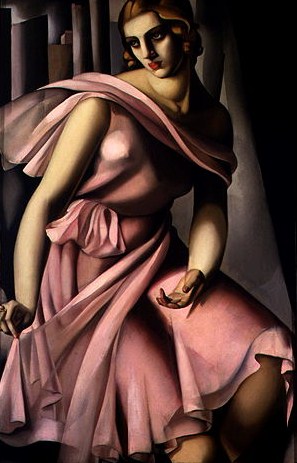
Portrait of Romana de la Salle ~ 1928 (Bottom)
Portrait of Romana de la Salle ~ 1928 (Bottom)
The two images above are courtesy of: http://www.delempicka.org
Beginning in 1922, Tamara participated in a variety of Parisian "salons" - particularly the Salon d'Automne and the Salon des Tuileries, both of which attracted large crowds and received a great deal of press coverage at the time. The purpose of these "salons" was to provide new artists with exposure, introducing them and their work to the general public. (For these first public appearances of her work, Tamara de Lempicka invariably used the masculine form of her family name: thus, the catalogues for these early exhibitions list her name as "Lempitzky," the name by which she used to sign her paintings at that time, instead of the Polish feminized version of her name, "Lempitzka.") But of the many salons and exhibitions held to promote the new and wildly popular Art Deco movement, a quintessentially French style that began in 1910 and which combined Cubism and design, none surpassed in scope or importance that of 1925's Exposition Internationale des Arts Décoratifs et Industriels Moderne, an exhibition dedicated to the display of modern decorative arts and from which the style officially acquired its appellation. The aim of the Exposition was twofold: to establish France's reputation as the world's leading authority in the realm of decorative arts while at the same time showcasing its pre-eminent supremacy in taste, novelty, design, and array of luxury goods; it was also at the Exposition Internationale des Arts Décoratifs that Tamara's reputation - as a valid artist - was firmly established. The Exposition was a defining moment not only in the history of the Art Deco movement but in the launch of Tamara's career as well. No doubt about it: from that moment on, Tamara's artistic career was on the ascend. (Sources: UXL Encyclopedia of World Biography, findarticles.com, 2003; vam.ac.uk, 2003)


Portrait of Constantin Stifter ~ 1924 (Above)
Perspective ~ 1923 (Left)
Rhythm ~ 1924 (Right)
The three images above are courtesy of: http://www.delempicka.org
As with any artist honing his or her craft, Tamara's style evolved through experimentation to what would eventually become her signature style, totally her own; initially, she began by dabbling with Cubism and flirting with Futurism. Her portraits were of people she knew within her social orbit, people she associated with: namely, the rich, the famous, the socially prominent but it also included members of her immediate family. Galleries began to take notice of her work and to hang her paintings in their best rooms; art critics raved over her erotically-charged portraits with their melancholic looks and hints at Sapphic eroticism.
During the "Deco Decades" of the 1920s and 1930s, Tamara de Lempicka produced paintings that would become not only famous but iconic. One of her most sought-after (and instantly recognizable, massedly-reproduced) pieces was "Auto-Portrait (Tamara In The Green Bugatti)." In this self-portrait, completed in 1925 and originally painted for the cover of the German Die Dame Magazine, a women's fashion magazine published by Deutscher Verlag in Berlin, Tamara portrayed herself as a modern woman at the wheel and fully in control of a speeding automobile: “dazzling and independent... who looks like she might fly away in her aquamarine car.” In 1927, a painting which featured her daughter entitled, "Kizette On The Balcony," won her first prize at the Exposition Internationale des Beaux-Arts in Bordeaux. Four years later, she would win a bronze medal at the Exposition Internationale in Poznan, Poland, for another portrait of her daughter, "Kizette's First Communion." In fact, in ten years' time, between 1923 and 1933, Tamara painted five large-scale portraits using Kizette as her model and inspiration. (Sources & quote: UXL Encyclopedia of World Biography, findarticles.com, 2003; delempicka.org, 2011)


The Sleeping Girl (Kizette) ~ ca. 1933 (Left)
Little Girl In Pink (Kizette In Pink II) ~ 1928/1930 (Right)
The above two images are courtesy of: http://www.delempicka.org

Kizette On The Balcony ~ 1927
Image above courtesy of: http://www.wikipaintings.org
Towards the end of the 1920s, Tamara had refined her own highly stylized "signature" (an amalgamation of Neo-Cubism and Mannerism) to such a degree - and so perfectly suited the era - that her art became emblematic of the period. With fame and recognition came love affairs with wealthy men - and, on occasion, women. The fact that she was a mother and a wife seemed to have mattered little to Tamara whose noted lovers included the Marquis Sommi Picenardi, a lover she took while on tour in Italy; Rafaëla, the reclining, voluptuous model of her 1927 painting, "The Beautiful Rafaëla" (La Belle Rafaëla), with whom she conducted a year-long affair; and Gabriele d'Annunzio, Italy's premiere poet, playwright and notorious womanizer, with whom the affair was merely a flirtation. (Tamara was more interested in completing a portrait of d'Annunzio that she was working on at the time than she was in consummating their affair; the relationship ended before the portrait could be finished.) (Source: UXL Encyclopedia of World Biography, findarticles.com, 2003)

The Beautiful Rafaëla (La Belle Rafaëla) ~ 1927
Image courtesy of: http://www.delempicka.org
By 1928, Tamara had established for herself a reputable career and, as a result, was living a financially secure, prosperous, and, by all standards, a sophisticated lifestyle. In Paris, she had also met and become acquainted with an Austro-Hungarian aristocrat who collected many of her paintings: Baron Raoul Kuffner de Dioszegh. A patrician landowner in what had formerly been the Austro-Hungarian Empire, Baron Kuffner descended from a wealthy family of brewers and breeders and had hired Tamara to paint a portrait of his mistress, Nana de Herrera. It was not long before artist and patron became lovers - while working on the commissioned work, Tamara became one of Kuffner's mistresses; she soon divorced Taduesz. In 1933, the Baroness Kuffner died of leukemia and Tamara, seizing her opportunity, stepped into the role of Baroness Kuffner; the two married in Switzerland (shortly after the Baron's wife's death) in 1933. Her new, second husband gave her everything she could have hoped for: a noble title, great wealth, and social status. (Sources: UXL Encyclopedia of World Biography, findarticles.com, 2003; delempicka.org, 2011)


De Lempicka became more in demand as an artist and continued to work energetically, painting everyone from writers, scientists, entertainers, and industrialists, along with some of Europe's displaced nobility and exiled, aimless royalty. She was so popular, in fact, that potential patrons - the wealthy and the royal alike - would stand in queue for the privilege of having their portraits painted by the famous Tamara de Lempicka. But with Europe facing political turmoil and a new menace in the form of a rising German Third Reich (1933-1945) and with another world war on the horizon, the glamorous life did not last too much longer. (Sources: UXL Encyclopedia of World Biography, findarticles.com, 2003; Blondel, A., en.lempickacatalogue.com, 2004; delempicka.org, 2011)

Portrait of Baron Raoul Kuffner ~ ca. 1939 (Left)
Self-Portrait ~ ca. 1939 (Right)
Both images above are courtesy of: http://www.delempicka.org
De Lempicka became more in demand as an artist and continued to work energetically, painting everyone from writers, scientists, entertainers, and industrialists, along with some of Europe's displaced nobility and exiled, aimless royalty. She was so popular, in fact, that potential patrons - the wealthy and the royal alike - would stand in queue for the privilege of having their portraits painted by the famous Tamara de Lempicka. But with Europe facing political turmoil and a new menace in the form of a rising German Third Reich (1933-1945) and with another world war on the horizon, the glamorous life did not last too much longer. (Sources: UXL Encyclopedia of World Biography, findarticles.com, 2003; Blondel, A., en.lempickacatalogue.com, 2004; delempicka.org, 2011)


The Blue Virgin ~ 1934 (Top)
Joan of Arc ~ 1932 (Top Left)
Saint Teresa of Avila ~ 1930 (Top Right)
Joan of Arc ~ 1932 (Top Left)
Saint Teresa of Avila ~ 1930 (Top Right)
The Peasant Man ~ ca. 1937 (Centre)
Peasant Girl With Pitcher ~ ca. 1937 (Lower Left)
The Peasant Girl ~ ca. 1937 (Lower Right)
Beggar With Mandolin ~ 1935 (Bottom)
The above seven images above are courtesy of: http://www.delempicka.org
But sometime in the early 1930s, although still highly popular and in demand, Tamara underwent a period of deep depression that seems to have foreshadowed (and complicated by) a personal mystical crisis. It was not a crisis of talent or clout, as evidenced by her demand, but her production slackened considerably. At this time, Tamara only focused on painting religious subjects: sorrowful Madonnas and saints. (Interestingly, her choice of saints depicted were those with reputations for deeply intense mysticism in the Roman Catholic tradition: John the Baptist, Teresa of Avila [based on the Bernini sculpture in the church of Santa Maria della Vittoria in Rome], Joan of Arc, and Saint Anthony.) By 1937, Tamara had attained a certain serenity, as reflected in her subject matter; turning aside from previous subjects, namely glamorous society ladies and rich industrialists, she began portraying ordinary persons of humble birth, simple peasant men and women, detailing their daily activities. It was as though the artist, encircled by wealth and fame, was yearning for a simpler life. At the time, so deep was her interest in spirituality and religious mysticism, that she underwent a temporary conversion - of sorts - which found her embracing the sort of ethical values that were at odds with the worldly vanities so esteemed by those in her usual circles. (Source: delempicka.org, 2011)

Image courtesy of: http://manavsevagujarat.com/
By 1939, the German Nazi Party - under the leadership of Adolf Hitler - was firmly established and its malignant influence was strongly felt across Europe; war, as was feared, loomed threateningly and inevitably. With high unemployment and a political atmosphere in chaos, it seemed out of place for self-indulgent rich art patrons to commission expensive self-portraits; galleries now sought abstract or surrealist paintings that appealed to the common masses - and reflected the mood of general unrest.
Having already been through the Russian Revolution and a First World War, Tamara was intuitively aware of what was about to happen in Europe: utter bedlam. Tamara had no intention of remaining in Europe to contend with yet another, second world war. With her encouragement, therefore, Baron Kuffner sold off his Hungarian land holdings and, in 1939, as Europe edged ever closer to the precipice of war, the Kuffners emigrated to the safety - and distance - of America, and away from the coming upheaval about to swallow Europe.
(Source: UXL Encyclopedia of World Biography, findarticles.com, 2003)
(Source: UXL Encyclopedia of World Biography, findarticles.com, 2003)


Woman With Mandolin (Femme à la Mandoline) ~ ca. 1933 (Left)
Portrait of Marjorie Ferry ~ 1932 (Right)
Portrait of Mrs. M. ~ 1932 (Bottom)
The four images above are courtesy of: http://www.delempicka.org
The Kuffners arrived in New York City in March of 1939, just ahead of the outbreak of the Second World War. With them, were some of Tamara's latest paintings along with several of her large-scale works, including the 1933 painting, "The Musician In Blue" ("Woman With Mandolin"). It was not Tamara's first visit to Manhattan - she had been invited there in 1929 to paint several portraits at the behest of some patrons; that voyage sparked several studies of the Manhattan skyline. (Skyscrapers had made such an indelible mark on Tamara's psyche that, upon her return to France, they appeared as backdrops in some of her new portraits of women.) But Tamara's intention of bringing along some of her older works was to eventually display them alongside some newer ones such as "Wisdom" and "At the Opera," which she had initially begun before leaving France but had not yet completed (they were finished in 1941). However, considering the era, no further portrait commissions were forthcoming; instead, she began to paint portrait after portrait of idealized young women and still-lifes. (Source: delempicka.org, 2011)


At The Opera ~ 1941 (Left)
Wisdom ~ 1941 (Right)
Wisdom ~ 1941 (Right)
Both images above are courtesy of: http://www.delempicka.org
After New York - and even a country retreat in Connecticut - the Kuffners headed towards the west coast: sun-drenched California. In Hollywood, they moved into a film director's former house in exclusive Beverly Hills. Soon, Tamara became acquainted and made friends with some of Hollywood's most notable movie stars - Dolores del Rio, Tyrone Power, and George Sanders among them. Her new Hollywood friends conferred on her a nickname: "The Baroness with a Brush." Tamara, in a clever publicity ploy and eager to make her presence felt, held a contest at the University of California-Los Angeles (UCLA) to find a model for her painting, "Susannah And The Elders." Adept at self-promotion, she took the initiative of sponsoring several of her own solo exhibitions at the Paul Reinhart Gallery (Los Angeles), the Julian Levy Gallery (New York), the Courvoisier Galleries (San Francisco), and the Milwaukee Institute of Art.
(Source: delempicka.org, 2011)
(Source: delempicka.org, 2011)


Young Lady With Gloves ~ 1930 (Left)
Portriat of A Young Lady And A Square Column ~ 1931 (Right)
Portriat of A Young Lady And A Square Column ~ 1931 (Right)
Both images above are courtesy of: http://www.delempicka.org
In 1943, the Kuffners moved back to New York. By now, Tamara's social life - and title - had begun to corrode her art and depreciated her reputation as a serious artist. Tamara de Lempicka, an artist who had married a baron, was now a woman of the past. Known as Baroness Kuffner, Tamara was now seen as a dilettante who had taken up painting merely as as a hobby; art was no more than a rich woman's interest. With America's fascination with European titles, the notion of a baroness dabbling with a paint brush and oils was an intriguing but charming curiosity. No longer taken seriously as an artist, Tamara painted less and her once-frenetic output diminished. With the end of the war and the return of peace, Tamara had to face the reality of a new, changed world - changes brought on by the casualties of war; even the art world and popular tastes had been shifted by the war years and she felt herself disconnected from and out of sync with the mainstream. In January 1949, she left for Italy, where she spent six months. From then on, Tamara would become a perpetual commuter between New York, Paris, Florence, Capri, Zurich, Monaco, Marrakesh, and other ports of call. (Source: delempicka.org, 2011)


As her production gradually slowed, Tamara disappeared from the art world for nearly twenty years. Tamara's travel frenzy may have been inspired, at least at first, as a distraction as well as by the need to escape the artistic displacement she was experiencing at the time. Refusing to allow herself to be beaten, she plunged into abstraction. She began with a composite style, lending each work a theme through a few figurative elements; she then gradually allowed these to merge into the abstraction of interlacing lines. Gradually, she began producing more purely abstract compositions, punctuated by geometric forms devoid of volume. Endeavouring to continue creating portraiture - a genre by which she established her worldwide acclaim - she began to replicate some of her best paintings from the 1930s. (It was a natural route to take: in the face of the "new" or untried, which is often crippling, one often deliberately reverts back to what one has done best or is best known for; this is especially true of artistic personalities and those who have been exceptionally successful, taking refuge and comfort in the familiarity of the past.) She may also have undertaken this new venture in the hope of jolting a new creative surge; unfortunately, it came to nought. By the late fifties, Tamara was again searching her way artistically. A small monograph published in 1957, for an exhibition in Rome, presents only works dating ten to fifteen years earlier, testifying to the artist's doubts with respect to her more recent production. (Source: delempicka.org, 2011)


Then, in 1960, she ventured into abstract art and tried to reclaim her artistic reputation (she undertook a series of paintings obviously inspired by the abstract painter Serge Poliakoff (1900-1969). Reverting to a figurative style, Tamara turned to landscapes and especially animals (often depicted in doubles): pigeons, roosters, rabbits, swans.) Unfortunately, when her work was exhibited at a retrospective show at the Ror-Volmar Gallery in Paris in 1961 as well as at New York's Iolas Gallery in 1962, both shows were met with disinterest. Wounded to the core and embittered by the dismal failure of the exhibits, she was unable to cope with such a disgrace; Tamara de Lempicka gave up painting as a career and never exhibited again. (On a tragic note, to exacerbate her dejected mood even further in the midst of her failed exhibitions, on November 3rd, 1961, while crossing the Atlantic on a return trip from Europe to New York aboard the S.S. Liberté, Baron Kuffner died suddenly of a heart attack mid-journey.) (Sources: delempicka.org, 2011; UXL Encyclopedia of World Biography, findarticles.com, 2003)


The Blue Scarf ~ 1930 (Left)
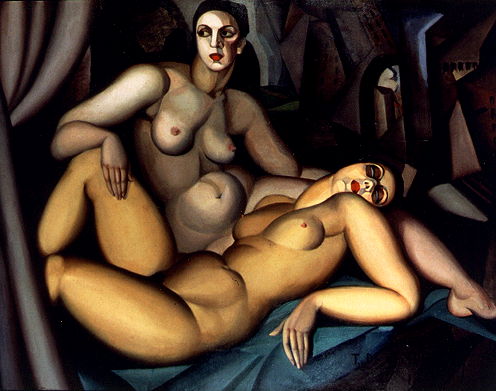
The Girls ~ 1930 (Right)
The Girls ~ 1930 (Right)
Both images above are courtesy of: http://www.delempicka.org
As her production gradually slowed, Tamara disappeared from the art world for nearly twenty years. Tamara's travel frenzy may have been inspired, at least at first, as a distraction as well as by the need to escape the artistic displacement she was experiencing at the time. Refusing to allow herself to be beaten, she plunged into abstraction. She began with a composite style, lending each work a theme through a few figurative elements; she then gradually allowed these to merge into the abstraction of interlacing lines. Gradually, she began producing more purely abstract compositions, punctuated by geometric forms devoid of volume. Endeavouring to continue creating portraiture - a genre by which she established her worldwide acclaim - she began to replicate some of her best paintings from the 1930s. (It was a natural route to take: in the face of the "new" or untried, which is often crippling, one often deliberately reverts back to what one has done best or is best known for; this is especially true of artistic personalities and those who have been exceptionally successful, taking refuge and comfort in the familiarity of the past.) She may also have undertaken this new venture in the hope of jolting a new creative surge; unfortunately, it came to nought. By the late fifties, Tamara was again searching her way artistically. A small monograph published in 1957, for an exhibition in Rome, presents only works dating ten to fifteen years earlier, testifying to the artist's doubts with respect to her more recent production. (Source: delempicka.org, 2011)


Portrait of Ira P. ~ 1930 (Left)
Portrait of Mrs. Bush ~ 1929 (Right)
Portrait of Mrs. Bush ~ 1929 (Right)
Portrait of Mrs. Allan Bott ~ 1930 (Centre)
The Telephone II ~ 1930 (Lower Left)
The Telephone II ~ 1930 (Lower Left)
Spring ~ 1930 (Lower Right)
The above five images are courtesy of: http://www.delempicka.org
Then, in 1960, she ventured into abstract art and tried to reclaim her artistic reputation (she undertook a series of paintings obviously inspired by the abstract painter Serge Poliakoff (1900-1969). Reverting to a figurative style, Tamara turned to landscapes and especially animals (often depicted in doubles): pigeons, roosters, rabbits, swans.) Unfortunately, when her work was exhibited at a retrospective show at the Ror-Volmar Gallery in Paris in 1961 as well as at New York's Iolas Gallery in 1962, both shows were met with disinterest. Wounded to the core and embittered by the dismal failure of the exhibits, she was unable to cope with such a disgrace; Tamara de Lempicka gave up painting as a career and never exhibited again. (On a tragic note, to exacerbate her dejected mood even further in the midst of her failed exhibitions, on November 3rd, 1961, while crossing the Atlantic on a return trip from Europe to New York aboard the S.S. Liberté, Baron Kuffner died suddenly of a heart attack mid-journey.) (Sources: delempicka.org, 2011; UXL Encyclopedia of World Biography, findarticles.com, 2003)


Nude With Sailboats ~ 1931 (Top)
The Blue Hour ~ 1931 (Left)
The Slave (also known as Andromeda) ~ 1929 (Right)
Nude With Dove ~ 1928 (Centre)
Nude With Buildings ~ 1930 (Bottom)
The above five images are courtesy of: http://www.delempicka.org
Distraught by her husband's death, Tamara decided to move to Houston, Texas, in 1962 where she could be nearer to Kizette and her two granddaughters. (Kizette had married a Texan geologist and moved to America in 1941.) Then, in 1966, the Musee des Arts Decoratifs in Paris commemorated the Art Deco period by staging a special exhibition - entitled, Les Anneés '25 - creating a resurgent interest and appreciation for this then-forgotten era of the 1920s and 1930s. Inspired by the exhibit, Alain Blondel opened the Galeire du Luxembourg and would eventually launch a major retrospective of Tamara de Lempicka's work in the early 1970s.
As mentioned, another retrospective, this one dedicated entirely to Tamara's work at the zenith of her renown, from 1925 to 1935, was mounted in 1972 by Alain Blondel at the Galerie du Luxembourg, Paris. Entitled, "Tamara de Lempicka de 1925 à 1935," this exhibit - although the object of Lempicka's drawn out hesitations - provided an opportunity for a new and, more crucially, younger generation to rediscover some of Tamara's best works from those decades. The extent of this show's success came somewhat of a surprise to Tamara, and gave her the feeling that her work had not been forgotten or in vain but was, in fact, appreciated anew; once again, her paintings were very much in demand, valuable commodities on the art market. Art lovers pressed her for more famous-titled works - such as the iconic "Autoportrait" (also known as "My Portrait") and "La belle Rafaëla" - which would once more bear her renowned signature. Finally acknowledging and yielding to their demand, she agreed to produce replicas of her most popular paintings. Unfortunately, she no longer had the same sure hand as she had forty or fifty years earlier; nor did she possess the same color perception that had lent a mauve cast to the originals: the newly reproduced copies she now created could niether compete with nor in any way be seriously taken as equals of those originals. “Meanwhile, for her own sake, she could be found - alone and in the silence of her studio - painting version after version of her venerated St. Anthony.”
(Sources: delempicka.org, 2011; quote: UXL Encyclopedia of World Biography, findarticles.com, 2003)


The Polish Girl ~ 1933 (Top)
The Breton Girl ~ 1934 (Centre )
The three images above are courtesy of: http://www.delempicka.org
Regrettably, de Lempicka did not live long enough to witness the enormous surge in popularity her work experienced during the 1990s. (In 1994, Academy Award-winner Barbara Streisand, who famously had a house filled with Art Deco furniture and artwork, auctioned the contents of her home. Included among the items sold was one of Tamara's paintings, the 1931 "Adam and Eve," which realized a final sale of $1.8 million; she had originally purchased it, in 1984, for $135,000.) (Source: UXL Encyclopedia of World Biography, findarticles.com, 2003)

Adam and Eve ~ 1931
Image courtesy of: http://www.alef.net
In 1974 and about six years before her death, Tamara de Lempicka decided to move permanently to Cuernavaca, Mexico. There, she bought a beautiful house called "Tres Bambus" in an upscale neighbourhood in 1978 where, a year later in 1979, Kizette joined her after her husband died. By this time, Tamara was quite ill. She spent her final days with her daughter at her bedside; she died peacefully in her sleep on March 18th, 1980. After Tamra's cremation and in accordance with her will, Kizette scattered her mother's ashes over the crater of Mount Popocatépetl, an active volcano.
(Source: UXL Encyclopedia of World Biography, findarticles.com, 2003)

Unfinished Self-Portrait ~ 1928
Image courtesy of: http://www.delempicka.org
“There are no miracles; there is only what you make.”

Suggested readings:
Passion By Design: The Art And Times of Tamara de Lempicka (1998), by Baroness Kizette De Lempicka-Foxhall & Charles Phillips: Abbeville Press
Tamara de Lempicka (1999), by Gioia Mori: Giunti Editore
Tamara de Lempicka: A Life of Deco And Decadence (2001), by Laura P. Claridge: Bloomsbury
Tamara de Lempicka: 1898-1980 (2001), Gilles Néret: Taschen
Tamara de Lempicka: Art Deco Icon (2004), by Tamara de Lempicka, Alain Blondel, Ingried Brugger, Tag Gronberg, Royal Academy of Arts (Great Britain) & Kunstforum Wien: Royal Academy of Arts
Tamara de Lempicka (2004), by Stefanie Penck: Prestel
Tamara de Lempicka: The Artist, The Woman, The Legend (2007), by Emmanuel Bréon: Flammarion
Tamara de Lempicka: The Queen of Modern (2011), by Gioia Mori: Random House Inc.