Showing posts with label Jazz. Show all posts

Tuesday, 12 April 2011

Wild Is The Wind: The Life & Music of Nina Simone


Nina Simone
(1933-2003)
Image courtesy of: http://daily-songs.com


“Jazz is a white term to define black people. My music is black classical music.”


Her proud voice, it has been insinuated, is an acquired taste: you either love it or you hate it. As a Southerner, her lyrics were laced with the bitterness of unjust insults and persecution of racism. Her independent spirit, never shy of expressing exactly how she felt, was matched by her vitriolic temper and mercurial temperament. Throughout her career, she knew the triumphs of success as well as the defeat of loss. Still, she could be gracious and generous when she wanted to be.

But whatever you may feel about Nina Simone, one thing is for certain: her integrity was resolute and she fearlessly stood by the principles she believed in; she was a staunch ally of those whom she supported in the struggle against inequality. She used her songs as a platform from which she addressed and protested the social injustices of the day, particularly during the Civil Rights Movement in the 1960s - she wrote Old Jim Crow and Mississippi Goddam, for instance, in response to the death of four black children in a church bombing in 1963.

More than a child-prodigy-turned-chanteuse, Nina Simone was a social activist.


The former Eunice Kathleen Waymon
Image courtesy of: http://www.morethings.com/


The sixth of eight children, Eunice Kathleen Waymon was born on February 21st, 1933, in Tryon, North Carolina. The daughter of Mary Kate Waymon (a strict Methodist minister who lived into her nineties) and John Divine Waymon, who, in spite of ill health also worked as a handyman and sometime barber, as a child, Eunice, along with some of her other sisters, sang  in her mother's choir at their local church and, from an early age, showed a prodigious musical talent with an aptitude for the piano. (Although the family lived in poverty, nonetheless, Eunice's mother encouraged  her musical inclinations.)

Mary Kate Waymon, her mother, worked as a maid and it was Mrs. Waymon's employer who, hearing of Eunice's talent (it is alleged that she was discovered playing God Be With You Till We Meet Again on the family organ - by ear and note-perfect in the F key - at the age of three) provided the necessary funds for the first piano lessons for her in 1939, when she was six years of age, in exchange for recitals at her library. (A local fund was eventually set up by her piano teacher to support the girl's continuing high school education and eventually through to the Julliard School of Music in New York City.) 

And it was there, at the town library, that Eunice's first public debut was held. It was a classical piano recital at which her parents, having sat at the front row to watch their daughter, were made to give vacate their seats and move to the back of the recital hall in order to make room for some White audience members just before the concert was to begin; an outraged ten-year-old Eunice reportedly refused to play until her parents were allowed to sit in the front row again. The experience of this racially-biased incident seared itself into Eunice's mind, never to be forgotten. (Simone rarely respected an audience thereafter: “I hate singing live,” she declared, “I only work in showbusiness for the money.”)
(Sources: last.fm, 2010; lyricsfreak.com, 2010; Hunter, K. D., solidarity-us.org, 2003; quote: telegraph.co.uk, April 23, 2003)


Nina Simone - Live at Ronnie Scott's in London ~ 1984
(Album Cover)
Image courtesy of: http://2.bp.blogspot.com/


After leaving the Julliard School of Music with an ambition to become the first Black classical concert pianist (her playing would always remain 'tinged' with traces of Bach), at the age of seventeen, Eunice decided to apply  for a scholarship at the equally prestigious Philadelphia's Curtis Institute of Music in Pennsylvania. When, however, Curtis Institute rejected her application, Eunice attributed it to racism: “When Curtis turned me down, I never got over it,” she was later quoted as saying. “I had never thought about being [B]lack before.” As a result of her failure to enter Curtis Institute, Eunice was obliged to become a piano teacher and accompanist for vocal students, whom she later referred to as “nasty little kids.” (Source & quote: telegraph.co.uk, April 23, 2003)
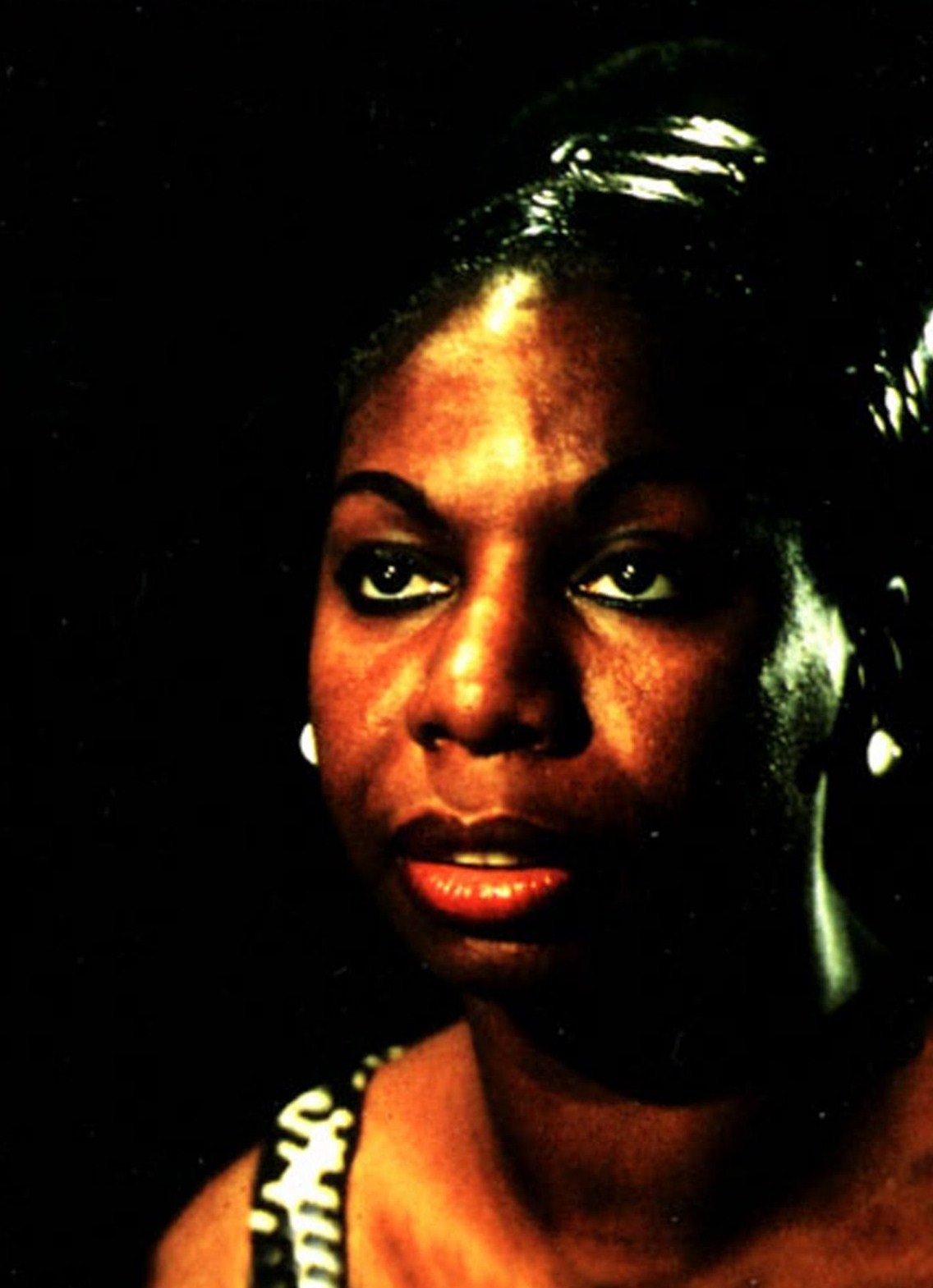

 Image courtesy of: http://www.smoothvibes.com/


In 1954, Eunice took a summer job (to support her schooling) at the Midtown Bar and Grill, a club on Pacific Avenue in Atlantic City, New Jersey, at which she thought she would be playing the piano. The owner thought he had hired a vocalist. After her first night, the club owner gave Eunice an ultimatum - either she sing at her next performance the following night or she would find herself out of a job. At the end of her performance, the audience response was so enthusiastic that Eunice decided to change her career from a solely piano performance to vocals. Now that she had embarked on a career as a nightclub singer-pianist, Eunice, out of fear of her mother's discovery and disapproval of her playing 'the devil's music,' adopted a new appellation for herself: Nina Simone. Nina, meaning 'little one,' was borrowed from a Hispanic boyfriend's nickname for her; Simone was taken from a French actress that Eunice admired, Simone Signoret, in the 1952 movie, Casque d'Or. (Incidentally, the indication is that Mrs. Waymon did not approve of her daughter's career in showbuisness - in forty years, she only came to two of her daughter's performances.)

It was in her new persona as Nina Simone that she was soon noticed, playing a mixture of jazz, blues and classical music at various clubs, creating a small but loyal fan-base for herself, which led her to record a rendition of I Loves You Porgy, a duet from the 1935 George and Ira Gershwin opera, Porgy and Bess (learned from a Billie Holiday album and performed as a favour to a friend). In 1959, it turned out to be her first - and only - top 20 hit of her career. (Sources: telegraph.co.uk, April 23, 2003; Hunter, K. D., solidarity-us.org, 2003; lyricsfreak.com, 2010)


Image courtesy of: http://www.htbackdrops.com/


No profile on Nina Simone would be complete without mention of her involvement in the struggle for racial equality. Having grown up in the South and experiencing racism first-hand, Nina embraced the Civil Rights Movement in the 1960s and fully supported Dr. Martin Luther King Jr.'s platform. Simone was initially brought into the movement by her good friend, the playwright Lorraine Hansberry (A Raisin in the Sun). It was because of her experiences with the movement that Simone wrote and recorded what is perhaps her most potent commentary on racism in America. As she conveyed in her 1993 autobiography, I Put a Spell on You, she was furious and  shaken to the core by the bombing of the 16th Street Baptist Church in Birmingham, Alabama, a heinous act which killed four innocent little Black girls. The attack - either ironically or deliberately - took place less than three weeks after Luther King's historic march on Washington and marked a turning point in the Civil Rights Movement as most of the movement's major figures, including Dr. King and SNCC's Stokely Carmichael (Kwame Toure) were pushed closer to the radicalism advocated by Malcolm X. Simone, who purportedly wanted to go out into the streets and shoot some White folks - a reaction which is in complete opposition to the movement's non-violence stance - transformed her rage, instead, into the powerfully scathing Mississippi Goddam. (Source: Neal, M. A., seeingblack.com, June 4, 2003)


Video courtesy of: RdclBlkFmnst ~ YouTube


The song was recorded live at Carnegie Hall in March of 1964. Simone's career would be radically altered by the recording; it lent a harder edge to her musical repertoire as she increasingly utilized her music as a vehicle in her campaign for change. (The beginning of the song has Simone cryptically announcing to her audience, “The name of this tune is 'Mississippi Goddamn'... and I mean every word of it.”) The lyrics for Mississippi Goddam are embedded, deceptively, in a swingy show tune beat that belies Simone's seething, vitriolic hatred for White America's racially-motivated mistreatment of its Black citizens and denounces its reluctance to desegregation. “This is show tune, but the show hasn't been written for it... yet,” she quietly begins. 

Mississippi Goddam then meanders into lyrical imagery of what it must have been like to be a Black person living in the South, especially at that time, as seen through the eyes of someone who has lived through the sting of racism: “Hound dogs on my trail / School children sitting in jail / Black cat crossed my path, I think every day is gonna be my last / Lord have mercy on this land of mine / we all gonna get it in due time / I don't belong here, I don't belong there, I've even stopped believing in prayer.” Then, after the song crescendos with the verse, “Don't tell me, I'll tell you / Me and my people just about due / I've been there so I know / Keep on saying 'Go slow,'” Simone quietly admonishes her audience by asking, “Bet you thought I was kidding, didn't you?” The song then picks up again, her pent up anger and frustration made apparent with the lines, “Picket lines, school boycotts / They try to say it's a Communist plot /  All I want is equality for my sister, my brother, my people and me / Yes you lied to me all these years / You told me to wash and clean my ears / And talk real fine, just like a lady / And you'd stop calling me 'Sister Sadie' / All of this whole country is full of lies / You all gonna die and die like flies / I don't trust you anymore / You keep on saying 'Go slow.'”

Simone would record other Black protest anthems such as Billy Taylor's I Wish I Knew How It Would Feel To Be Free, a long-time favourite of protest marchers, and Why? (The King of Love is Dead), her musical eulogy to Martin Luther King, Jr. (Source: Neal, M. A., seeingblack.com, June 4, 2003)


Image courtesy of: http://www.morethings.com/


Following disagreements with her record label and feeling generally disenchanted with America, Simone left the United States in 1971 and flew to Barbados, expecting her husband and manager, Andrew Stroud, to inform her of her next performance. (Her marriage to Stroud was apparently fraught with violence.) Stroud, however, interpreted Simone's sudden disappearance (and the fact that she had left behind her wedding ring) as a signal for a divorce. As her manager, Stroud was also in charge of Simone's finances, which meant that after their separation, Simone had no knowledge about how her business was managed or what her financial worth was. Returning to the United States, she was dismayed to learn that she was wanted for unpaid taxes, the knowledge of which instigated her return to Barbados and her evasion of the Internal Revenue Service authorities and prosecution. Simone remained in Barbados for quite some time, and had a lengthy affair with the Prime Minister, Errol Barrow.

In the 1980s, Simone performed regularly in England at Ronnie Scott's Jazz Club in London. (To the astonishment of her audience, on one occasion she arrived for a performance on stage at Ronnie's wearing a mink coat and training shoes, with a plastic shopping bag in hand; in 1989, a live album, Live At Ronnie Scott's, was released.) A close friend, singer Miriam Makeba, persuaded her to go to Liberia and she lived there for about four years. After which, she lived in Switzerland and in Nijmegen, Holland; she finally settled in Aix-en-Provence, in the South of France, in 1995.
(Sources: lyricsfreak.com, 2010; last.fm, 2011; telegraph.co.uk, April 23, 2003)


Image courtesy of: http://www.last.fm/
 

Nina Simone has been recognised for her musical as well as humanitarian contributions. In 1974, On Human Kindness Day in Washington D.C., ten thousand people gathered to pay tribute to Simone, there to receive two honorary degrees in music and humanities from the University of Massachusetts as well as from Malcolm X College. After her degrees, Simone preferred to be adressed as 'Dr. Nina Simone.' More poignantly, in 2003, two days prior to her death, Curtis Institute of Music - the same college that had, decades ago, refused Eunice Waymon's application - awarded her an honorary diploma. (Source: lyricsfreak.com, 2010)


Throughout her career, Nina Simone recorded over forty live and studio albums. She wrote some songs and covered others. Some of her best-known numbers include: My Baby Just Cares for Me, I Put A Spell On You, Four Women, I Loves You Porgy, Feeling Good, House of the Rising Sun, Don't Let Me Be Misunderstood, Sinnerman, To Be Young, Gifted and Black, Mississippi Goddamn, Ain't Got No/I Got Life and I Want a Little Sugar In My Bowl and Ne Me Quitte Pas. Many hip-hop artists and disc jockeys sample and remix her songs, introducing them to new audiences who may not necessarily be as aware of Simone's career and contributions to music.

Currently, some of her songs, such as the remixed version of Sinnerman, are used in television advertisements. Her music has also surfaced in such popular television series as Sex And The City as well as in movies, including: The Big Lebowski (1998), Point of No Return (also known as The Assassin, 1993) Notting Hill (1999), The Thomas Crown Affair (1999), Before Sunset (2004), Inland Empire (2006), Sex And The City (2008), Revolutionary Road (2008), and Watchmen (2009).

After battling breast cancer for a few years, Nina Simone, aged seventy, died at home in her sleep on April 21st, 2003, in Carry-le-Rouet, Bouches-du-Rôhne, France. Her ashes were reportedly scattered in several African countries. Her only daughter, Lisa Celeste, an actress/singer, took the stage name of 'Simone'. (Source: lyricsfreak.com, 2010)


The above three images are courtesy of: http://www.last.fm/


It would seem that there could not have been two more disparate entities than Nina Simone and the Parisian House of Chanel. But for a brief moment, the two converged and the result was a highly successful venture for both. My Baby Just Cares For Me, a snappy tune originally written by Gus Khan and Walter Donaldson in 1928 for a Ziegfeld musical Whoopee! and recorded by Simone for her 1957 debut album, Little Girl Blue, was a fairly obscure melody (Little Girl Blue was released in 1958 by Bethlehem Records); until, that is, 1987. It was in that year, thirty years after its original recording, that the song - with Simone on vocals and piano - was used as the cover for a television advertisement in the United Kingdom for Chanel's No. 5 perfume, featuring the French actress Carole Bouquet. (Source: lyricsfreak.com, 2010)

The commercial was a phenomenal success: it rejuvenated the image of No. 5 while at the same time it generated much new interest in Nina Simone. The popularity of this once-forgotten recording led to its re-release as a single; it debuted at number 5 on the U.K. singles chart. (However, due to the her decision to sell the rights to all the songs on  her Little Girl Blue  album when she signed with her record company at the time, Simone was not entitled to much of the profits made from the sale of the single: from the 175,000 copies sold, Simone reportedly received the paltry sum of $20,000 in royalties because Charly Records had 'licensed' the record from its American owners.) My Baby Just Cares For Me is still the most identifiable Nina Simone 'trademark' and one very closely associated with her name. 
(Sources: Hunter, K.D., solidarity-us.org, 2003; telegraph.co.uk, April 23, 2003)


Video courtesy of:  ~ YouTube


Subsequently, sixteen years after the success of the Chanel No. 5 advert, another venerable French House, that of Christian Dior, followed suit. In 2003, under Dior's then creative director, John Galliano, Oscar-winning actress Charlize Theron (directed by Nick Knight and photographed by Michael Balhaus) starred in the sensuous J'Adore Dior perfume advertisement set to the score of yet another Nina Simone classic, Don't Let Me Be Misunderstood.
(Source: admusicdb.com, 2009)


Video courtesy of:  ~ YouTube


Photograph by Carol Friedman/Corbis ~ 1994

Photograph by Peter Williams/Corbis ~ 1997
The above two images are courtesy of: http://www.radio.ge/


In 2002, the groundbreaking Verve Remixed compilation series  was first  introduced. It ingeniously coupled today's most innovative disc jockeys together with some of the most popular archived hits from the Verve Records' catalogue by yesteryear's greatest crooners. Featuring luminaries such as Ella Fitzgerald, Sarah Vaughn, Billie Holiday, Shirley Horne, Dinah Washington, Anita O'Day and others, over the years, the Verve Remixed series established itself as one of the most ground-breaking and successful series in music. In each edition of the series - 1 through 4 (2002-2008), along with the Verve Remixed Deluxe Box Set (2005) - a couple of Nina Simone's timeless songs have always been featured (and cleverly remixed), including  the Joe Claussell/Thievery Corporation smooth urban remix of Feeling Good.
(Source: ververemixed.com, 2009)


Video courtesy of:
[Joe Claussell/Thievery Corporation Remix]


Video courtesy of:
[Felix Da Housecat Heavenly House Vocal Remix]
The  above  two videos are both courtesy of YouTube


Image courtesy of: http://www.gplondon.com/


Nina Simone's life will soon be brought to the silver screen. Written and directed by Cynthia Mort, Nina (Ealing Studios) stars Mary J. Blige and David Oyelowo in a biographical film which revolves around Nina Simone's relationship with her assistant, Clifton Henderson. (Source: imdb.com, 2010)

But Nina is not the first film to be made of Simone's life. Nina Simone: La Légende (1992) is a television documentary made by Frank Lords - produced in association with La Sept (La 7), British Broadcasting Corporation (BBC) and System TV. The film is a personal portrait of the legendary vocalist and musician which included interviews with Nina as well as with members of her intimate circle of friends, relatives and colleagues - all chronicling Simone's life and musical journey. In one touching scene, the film follows an emotional Simone on her visit - the first in many years - with her mother and siblings at her childhood home in North Carolina. (Source: imdb.com, 2011)


Video courtesy of: 


Video courtesy of:


Video courtesy of:


Video courtesy of: Monke96ify


Video courtesy of:


Video courtesy of:


Video courtesy of:


Video courtesy of: LucaC1993Production


Video courtesy of:
The above nine videos are all courtesy of YouTube


“I had spent many years pursuing excellence, because that is what classical music is all about... Now it was dedicated to freedom, and that was far more important.”


Image courtesy of: http://cache1.bigcartel.com


Suggested readings:


I Put A Spell On You (1993, 2003), by Nina Simone & Stephen Cleary: Da Capo Press

Nina Simone: Break Down & Let It All Out (2004), by Sylvia Hampton & David Nathan: Sanctuary

Nina Simone (2004), by Kerry Acker: Chelsea House Publishers

Nina Simone - Black Is The Color (2005), by Andy Stroud: Xlibris Corporation

You're The Voice (2006), by Nina Simone & Anna Joyce: Faber Music Ltd. 

Princess Noire: The Tumultuous Reign of Nina Simone (2010), by Nadine Cohodas: Pantheon


Monday, 15 November 2010

I like a Gershwin tune ~ how about you?


George Gershwin
(1898-1937)
Image courtesy of: http://www.vinylrevinyl.com/


“Life is a lot like jazz... it's best when you improvise.”


The man who would become known as George Gershwin was, in fact, born Jacob Gershowitz in Brooklyn, New York, on September 26th, 1898, to immigrant Russian-Jewish parents who came to America in 1891. As a child, he excelled at outdoor sports and activities but did not show any inclination towards music until the age of around twelve, when a piano was brought home for his brother, Ira. True to form, George immediately took an interest in the instrument and began to play a popular tune he had heard played on a neighbour's player piano and had memorised. This did not go unnoticed by the Gershowitzes; at the age of thirteen, his parents decided to invest in their son's evident talent by sending him to study music. George began studying with several composers, among them: Rubin Goldmark, Henry Cowell, Wallingford Riegger and Joseph Schillinger. By age of fifteen, having quit school altogether, he was already earning $15 per week playing for a Tin-Pan Alley publishing firm called, Jerome H. Remick & Co. (Source: balletmet.org, 2000)


To to supplement his income, he recorded what was known as piano rolls under various pseudonyms, thus earning a much-needed $35 for every six rolls of music produced.  It was also at this time in his life that he decided to change his last name from Gershowitz to Gershwin: he had admired the comedian, Ed Wynn, so he simply dropped the "witz" and incorporated "win" from Wynn, creating his newly-adapted surname. His first published song came in 1916, When You Want 'em; but it was the success of his first real hit, Swanee, written for a revue at the just-opened Capitol Theater in 1918, that established his reputation as a composer. Its success - the unparalleled hit of his entire career - was brought about when Al Jolson sang it in Sinbad. (Source: balletmet.org, 2000)  


As an American composer of international renown, Gershwin was one of the first to introduce jazz rhythms into popular songs - some of his best-loved songs are The Man I Love, I Got Rhythm, and the dolefully beautiful, Someone To Watch Over Me - all mainstays of the greatest crooners of our time. George and his brother, Ira, collaborated on a number of revues and musical comedies as well: Scandals (1920-24), Lady Be Good (1924), Funny Face (1927), and Of Thee I Sing (1931) - the first musical comedy to be awarded a Pulitzer Prize. Ira was responsible for writing the lyrics of nearly all of George's songs. But perhaps his most recognisable work was undertaken in 1924, when Paul Whiteman, the bandleader, commissioned George to write a work for a piano and jazz band; he wrote it in less than three weeks: Rhapsody In Blue. The haste with which it was written was mainly due to the fact that George had completely forgotten about his commitment. He only recalled it when Ira read about the upcoming concert in the newspaper and George set to work on it post-haste. (Source: balletmet.org, 2000)  


It has been said that Gershwin's inspiration for the rhythm of Rhapsody In Blue came from the rhythm of the train on which he was travelling to Boston. As it has been recounted by Gershwin, much of the work came to him on that journey, "with its steely rhythms, its rattlety-bang... I suddenly heard - and even saw on paper - the complete construction of the rhapsody from beginning to end. I heard it as a sort of musical kaleidoscope of America - of our vast melting pot, of our unduplicated national pep, of our blues, our metropolitan madness." The music itself was written in a week on his return to New York. The success with which Rhapsody In Blue met led Gershwin to write other pieces for piano, including Concerto in F (1925). His other evocative piece is An American in Paris, written in 1928, and takes the listener to the heart of the French capital in the 1920s - it even includes four car horns to recall the chaotic traffic noise of the city.
(Cited from: balletmet.org, 2000)  


An American in Paris was inspired by a trip the Gershwins took to Paris in 1928. The thematic intent behind the work was that he wanted not only to capture some of the capital's spirit, but also the carefree attitude of his compatriot Americans vacationing in Paris as well. For the sake of authenticity, Gershwin visited Parisian garages where he purchased real car horns which he incorporated into the score later on. An American in Paris premiered at Carnegie Hall in December, 1928, and was quickly transferred from the concert hall to the musical stage, into a ballet scene of the musical, Show Girl. Then in 1930 came the last (and probably the greatest) of Gershwin's lighthearted musicals, Girl Crazy - it starred Ginger Rogers; it was also the stage debut of a neophyte Ethel Merman. In the pit, musicians such as Benny Goodman and Glenn Miller played. Success followed success: in 1932, Of Thee I Sing received the Pulitzer Prize; as was mentioned earlier, it was the first musical to do so. However, it came as a posthumous prize. Being an award for writing, the prize went to Ira Gershwin, George S. Kaufman and Morrie Ryakind; George received his musical recognition on the centenary of his birth, in 1998. (Source: balletmet.org, 2000)  


Up until 1935, Gershwin's work had met with resounding success. That was not the case with his next piece, a controversial opera: Porgy and Bess. Based on the 1925 book Porgy by author DuBose Hayward, and set in the South, the composition was Gershwin's greatest endeavour. It failed to receive the recognition he had hoped it would. Later, it was revived on Broadway (in 1942 and again in 1953); in 1959 it was made into a motion picture, directed by Otto Preminger. Today it is considered a Gershwin masterpiece. (Source: balletmet.org, 2000)  


In 1927, Gershwin took up painting and drawing as a hobby; the previous year he had begun to collect contemporary art. His interest in art became an increasingly important pastime over the years. At the pinnacle of his career, his life came to an abrupt end on July 11, 1937. While working in California on the score of his last composition, The Golden Follies, Gershwin collapsed into unconsciousness. After lapsing into a coma, he later died of a brain tumour. Tragically, Gershwin was only 38 years of age. 

He once aptly said, "True music... must reflect the thought and aspirations of the people and time. My people are Americans. My time is today." And so it is; the greatness of his music is still alive today and used in numerous films and musicals. They are classics. (Cited from: balletmet.org, 2000)


The above fifteen videos are all courtesy of: YouTube


Recommended readings:


The Gershwin Years: George and Ira (1996), by Edward Jablonski & Lawrence D. Stewart: Da Capo Press

Gershwin: With A New Critical Discography (1998), by Edward Jablonski: Da Capo Press

George Gershwin (1998), by Rodney Greenberg: Phaidon

George Gershwin: A New Biography (2003), by William Hyland: Greenwood Publishing Group

The George Gershwin Reader (2004), by Robert Wyatt & John A. Johnson: Oxford University Press

George Gershwin: His Life and Work (2006), by Howard Pollack: University of California Press

The Memory of All That: The Life of George Gershwin (2007), by Joan Peyser: Hal Leonard

George Gershwin: An Intimate Portrait (2009), by Walter Rimler: University of Illinois Press


Thursday, 4 November 2010

Lyrical Adroitness: The Cole Porter Songbook


Cole Porter
(Photo by Richard Avedon - September 13, 1950)
Image courtesy of: http://perpenduum.com/


“Most gentlemen don't like love, they just like to kick it around.”


Cole Porter was born to Kate Cole and Sam Porter - from whose combined surnames he derived his name - on June 9th, 1891, in Peru, a small town in Indiana. Although he studied both the violin and the piano, Cole preferred the piano, which he would play for two hours per day, to the harsh sounds of the violin. Musically, the biggest influence on Cole's early school life was Dr. Abercrombie, his teacher at Worcester Academy in 1905. It was Dr. Abercrombie who taught Cole about the relationship between words and meter. Cole later quoted from Ambercrombie's lessons: "Words and music must be so inseparably wedded to each other that they are like one." (Citation courtesy of: J.X. Bell, coleporter.org: Undated)


It was at Yale University that Cole's emerging, imaginative talent for composition became apparent in the football fight songs he wrote. At Yale, Cole composed several full productions per year in addition to individual songs for the Yale Dramatic Association and the Yale Glee Club. He wrote musical shows for student groups intended primarily for a Yale audience. It was during these formative experiences that Cole honed his plot productions and developed his songwriting wit - later to become the signature hallmarks of his professional musicals.
(Source: J.X. Bell, coleporter.org: Undated)


The Yale musical productions were also to prove helpful in another way: Cole made important connections which he found advantageous to his career on Broadway. In total, by the time he graduated, Cole had written six full-scale productions and approximately 300 songs, all of which he left to Yale University. After Yale, Cole tried his hand at law at Harvard, at which he was not successful. In his second year at Harvard, Cole decided to switch from law school to the school of arts and sciences in order to pursue music. In 1914, however, he abandoned his Harvard studies altogether, moved to the Yale Club in New York in 1915, and began his professional music career. (Source: J.X. Bell, coleporter.org: Undated; Robert F. Howe, smithsonianmag.com, 2004)


Cole's first venture into musical theatre, See America First (1916), was not a success and the reviews were disparaging. It was described by the New York American as a "high-class college show played partly by professionals." The following summer, in 1917 while war was still ravaging most of Europe, Cole set out for Paris, where he carved himself a reputation of a wealthy American living in Paris. To the American press, he concocted stories about his time in France, claiming that he was working with the French Foreign Legion and the French army. Back in America, this supposed 'involvement' in the war effort on behalf of France garnered him a reputation as a war hero, an image of himself that he fostered for the rest of his life. (Source: J.X. Bell, coleporter.org: Undated; Robert F. Howe, smithsonianmag.com, 2004)


The parties during the Paris years were elaborate and fabulous, involving some of the social luminaries of the wealthy and political classes. His parties had a decidedly decadent allure to them involving gay and bisexual activity, cross-dressing, international musicians, and a large surplus of recreational drugs.

It was in 1918 that Cole met an affluent, older American divorcee, also in Paris at that time, by the name of Linda Lee Thomas; by 1919,  the two had become close friends and they were regularly spending time together. Without the presence of family members, Linda and Cole married on December 19, 1919. Although not a conventional marriage by any means, it was more of an arrangement, a mutual understanding between two parties - having already been through an abusive marriage once before, Linda was not bothered by Cole's homosexuality - at least not in the early stages of their marriage (some say it made the prospect of a sexless marriage with Cole all the more palatable).

Just as his mother before her, Linda undoubtedly believed in Cole's musical talents and she was and would always remain one of Cole's staunchest supporters. They remained a married couple till Linda's death in 1954. Throughout this marriage of convenience (Cole recognised in Linda the sophistication and the means to social advancement, while Linda saw in Cole a portal to a seductive world of fame and show business) Cole carried on with his own extramarital affairs with men.
(Source: J.X. Bell, coleporter.org: Undated; Robert F. Howe, smithsonianmag.com, 2004)


In 1923, the Porters' finances were bolstered when Cole inherited, in cash, $1 Million upon his his grandfather's death. With money to spare, the Porters became a fixture on the international social circuit - London, New York, Paris and Venice - (in Paris, where the couple bought a spacious, lavishly decorated apartment, they simply became known as Les Colporteurs). Towards the end of the 1920s and into the 1930s, Cole's star was in ascendancy. He wrote several songs which became staples of the times and remain so to this day - "I Love Paris," "Let's Do It," "Love For Sale."  
(Source: Robert F. Howe, smithsonianmag.com, 2004)


Robert Kimball, editor of The Complete Lyrics of Cole Porter, says, "He was very candid about love and sex in his lyrics and he went against the censorship of his day. He made it easier for other writers to follow suit."

Likewise, Stephen Citron, the music historian, tends to agree: "The other great composers didn't have the depth of imagination in terms of music. Porter's musical execution was so avant garde that it's still fresh... He wrote lyrics about love and romance, but he also wrote about homosexuality, cocaine, brutality, gigolos - subjects that were défendu at the time, but things that we talk about all the time today. That's why audiences today still find excitement and newness in Porter's work." Perhaps this is why with each new interpretation and rendition of Cole's songs by successive generations of artists, his songs lend themselves to modern ears, garnering admirers from today's audiences.
(Cited from: Robert F. Howe, smithsonianmag.com, 2004)


Increasingly, Cole Porter's hits established his reputation as an acclaimed lyricist of some renown. These included: Fifty Million Frenchmen (1929), The New Yorkers (1930), Anything Goes (1934), Jubilee (1935) and Red, Hot, and Blue! (1936). Linda Porter developed the habit of holding a dinner party for each opening night in New York, where the Porters maintained adjacent apartments on the 41st-floor of the Waldorf-Astoria. Linda also established another premiere night tradition: she presented Cole with a custom-made new cigarette case on which  was inscribed each  production's name and date. Her devotion (and pride) in her husband's career was evident in another, more intimate form: Linda kept a scrapbook in which she assembled  review clippings, photos, ticket stubs and theatre programs (currently housed at Yale University). (Source: Robert F. Howe, smithsonianmag.com, 2004)


In 1935, Cole and Linda embarked on to a new venture: Hollywood. But though Cole worked on films based on his Broadway musical productions, he also gathered round him a homosexual coterie from which Linda felt herself excluded; his lifestyle, she felt, jeopardized his Hollywood career. In 1937, having failed to convince Cole to leave Hollywood behind, Linda left for their Paris apartment and, for the first time, contemplated divorce. Cole hurried after her. In the autumn of 1937, Cole sailed back to New York - alone.

While visiting a friend's farm on Long Island shortly after his return, Cole went horseback riding. The horse he was riding fell and landed on him, crushing both his legs. Upon hearing of Cole's accident, Linda rushed to his side. After a couple of medical consultations, both of whom recommended amputation of the right leg (and possibly the left), Linda (and Cole) refused the decision to amputate; his leg eventually healed. The riding accident brought the couple closer together than ever before and cemented their relationship. Linda had stood by her husband's side in his time of distress and, later on, when his wife fell ill with respiratory ailments, Cole would also stand by his wife in her time of distress. 
(Source: Robert F. Howe, smithsonianmag.com, 2004)


There were numerous surgeries on his legs and much pain over the years due to the horse riding accident, but although at times the anguish caused him to fall into severe melancholy and become self-conscious about his legs, he never stopped writing some of his most timeless songs: Leave It To Me (1938), Kiss Me, Kate (1948 - based on Shakespeare's Taming of the Shrew and possibly Cole's most acclaimed musical) and Can-Can (1953).   

Linda decided to close their Paris apartment and move to the States permanently, where she bought herself a property in Williamstown, Massachusetts, and converted its carriage house into a work studio for Cole. By early 1949, however, Linda's health declined severely as she developed pleurisy. For health purposes, she retreated to Arizona while Cole resumed his work in Hollywood, traveling to frequently to Arizona to be with his wife. Linda recovered sufficiently enough to be able to return to the couple's Waldorf-Astoria suites, where she died in May of 1949. Cole was devastated. He decided to bury his wife in the Porter family plot in Peru, Indiana. (Source: Robert F. Howe, smithsonianmag.com, 2004)


In 1958, Cole lost his right leg to bone disease, for which he had to have a prosthesis made. As people often do when faced with a life-altering circumstance over which they have no control of,  he became severely depressed; Cole turned to drugs and alcohol for self-medication. So intense was his depression and outlook on life, that in the six years which followed the operation, he wrote no new songs. After fracturing his hip and suffering from complications of a bladder infection and  pneumonia, Cole died on October 15th, 1964. Like his wife before him, he is buried in the Porter family plot in Peru, Indiana. It is alleged that he is buried between his mother, Kate, and wife, Linda.
(Source: Robert F. Howe, smithsonianmag.com, 2004; J.X. Bell, coleporter.org: Undated)


The above sixteen videos are all courtesy of: YouTube


Recommended readings:


Cole Porter: 100th Anniversary (1990), by Cole Porter: Alfred Publishing Co., Inc.

The Complete Lyrics of Cole Porter (1992), by Cole Porter & Robert Kimball: Da Capo Press

Cole Porter (2000), by William McBrien: Random House of Canada

Hot 'n Cole: A Cole Porter Celebration (2000), by Cole Porter, David Armstrong, Mark Waldrop
& Bruce Coyle: Samuel French Inc.

Simply Porter: The Music of Cole Porter (2007), by Cole Porter & Dan Coates: Alfred Music Publishing

Cole Porter (2008), by Patrick O'Connor: Yale University Press

Cole Porter (2010), by Frederic P. Miller, Agnes F. Vandome & John McBrewster: VDM Publishing House Ltd.