Jaguar ~ (Panthera Onca)
Video courtesy of: David Torres ~ (Vimeo)
“It is in fact a common phenomenon of South American shamanism (reflected also in Mesoamerica) that shamans are closely identified with the jaguar, to the point where the jaguar is almost nowhere regarded as simply an animal, albeit an especially powerful one, but as supernatural, frequently as the avatar of living or deceased shamans, containing their souls and doing good or evil in accordance with the disposition of their human form.” (Furst, 1976:48)
Video courtesy of: David Torres ~ (Vimeo)
Revered by ancient Pre-Columbian cultures as a god, the jaguar (Panthera onca) was simultaneously admired and feared for its hunting prowess and strength. To the indigenous peoples of the Americas, the elusive jaguar, with its mirror-like eyeshine reflecting back light in the darkness of the night, came to represent beauty, power, cunning, and mystery - and, in time, those qualities were woven into the rituals and legends of ancient tribes. The Mayans, for instance, had a poetic proverb: Spread the jaguar's skin and you spread the heavens of a starry night. In other stories, the jaguar was not strictly relegated to the splendour of a glittery firmament; it prowled the heavens in the daytime as well.

Jaguars of the Mayan Underworld
The Underworld jaguars all wear mushroom-shaped ear plugs as well as sacrificial scarves, symbolic of underworld decapitation
(Photograph by Justin Kerr)
Image & source courtesy of: http://mayavasepro.webs.com
Also according to one Mayan myth, the jaguar - a word derived from the Native (American) Indian root-word yaguar or yaguara, which means "he who kills with one bound" - was a supernatural being: "Jaguar Sun" rose each day in the east and prowled its way westward, aging incrementally along the course of the day, until, finally, it plunged into the western darkness. There, throughout the night, Jaguar Sun battled with the Lords of Xibalba (the Underworld). By his strength, tenacity and cunning, Jaguar Sun was regenerated and won his right to rise anew each day, victorious, on the eastern horizon. (Sources: oneworldjourneys.com, 2001-2002; arkive.org, 2011; nationalgeographic.com, 2011)
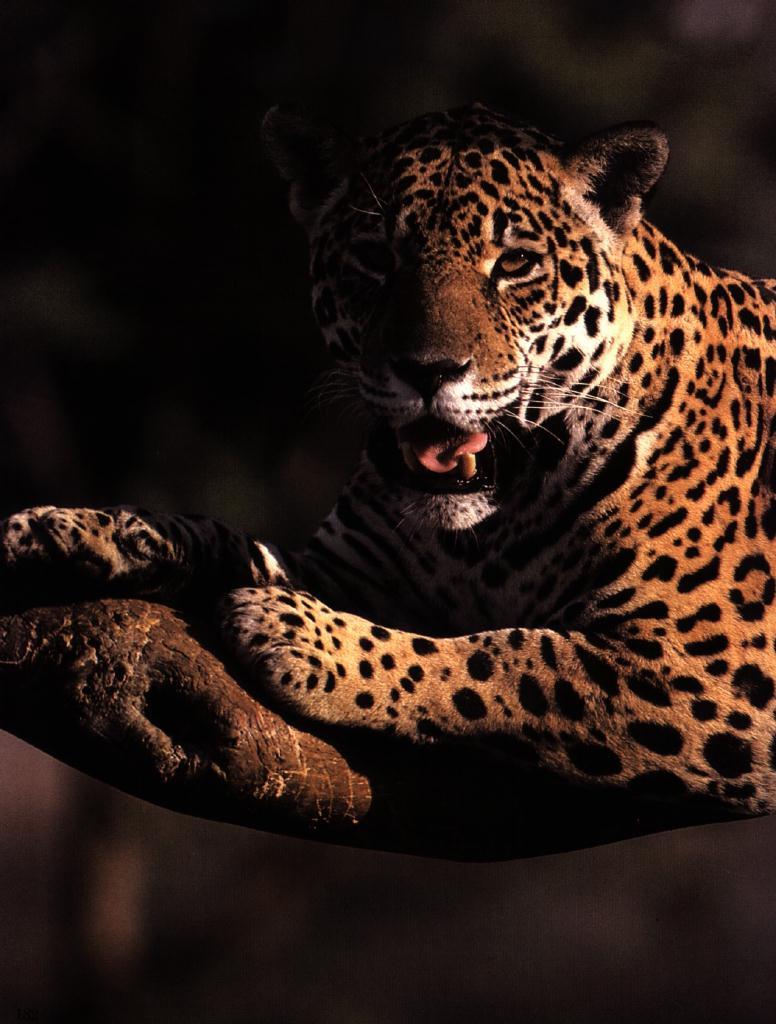
Image above is courtesy of: http://www.animalpicturesarchive.com

Image above is courtesy of: http://misswalkerswiki.wikispaces.com
Often confused with the leopard, the jaguar is the largest cat on the American continents whose habitat once ranged from the southern tip of South America, through Central America and as far north into the North American continent as the region surrounding the U.S.-Mexico border (California, Arizona, New Mexico and Texas. It is extremely rare in the United States and is considered to be an endangered species by the federal government). (Being the largest cat in the Western Hemisphere and the third largest in the world, the jaguar is only out-sized by its African and Asian kin: the lion and the tiger.) Although in recent years they have occasionally been seen and photographed in southern Arizona, they presently survive mainly in remote regions of South and Central America, ranging from Mexico to the northern parts of Argentina. Today, any significant numbers of jaguars are found primarily in the Amazon basin. Due to a number of factors, such as their scarcity and diminishing numbers - they are currently classified as 'Near Threatened' by the IUCN [International Union for Conservation of Nature and Natural Resources] List of Threatened Species - their elusive nature and their propensity to hunt mainly at night, jaguars are possibly the least studied and understood of all the great and magnificent cats. (Sources: nationalgeographic.com, 2011; arkive.org, 2011; nhptv.org, 2011)

Image above is courtesy of: http://bionarede.blogspot.com
 (Photograph by Jim Dicecco)
Image above is courtesy of: www.thebigcats.com

Image above is courtesy of: www.thebigcats.com
Even though visually similar in appearance to the agile leopard, the jaguar is, in fact, stockier and heavier than a leopard with a shorter, thicker tail (45 to 75 centimeters in length). It possesses a muscular build (a male jaguar typically weighs anywhere from 54 to 136 or even as much as 159 kilograms), suitable to a predator: a deep chest, a large head, a broad muzzle, and powerful jaws. (It stands about three-feet tall from shoulders to feet, and 6½ to 7½ feet long from nose to tail.) But the confusion between leopards and jaguars stems mainly from the similarity in their coat colours and patterns; in particular, the clusters of 'rosettes' shared by both animals. The black 'rosette' spots of leopards, who roam the wilds of Africa and Asia, are completely solid and their 'rosette' edges are 'unbroken'; whereas the jaguar's 'rosettes,' on the other hand, are large and irregular with 'broken' borders and usually with a spot enclosed at their centres. The 'rosettes' of a jaguar's coat are set against a striking golden-brown-to-yellow fur, which pales to white on the cheeks, throat and underside. (The jaguar's head, legs and tail have single spots.) Scientists believe that the colouring and spotting of their coats - like the spotted and patterned coats of all predatory cats - helps jaguars hide from their prey, breaking up their outlines in forests and grasslands where they hunt, blending them with their backgrounds. (Sources: Zoological Society of San Diego, sandiegozoo.org, 2011; arkive.org, 2011; nationalgeographic.com, 2011; nhptv.org, 2011; animal.discovery.com, 2011)

And therein lies the allure of the jaguar - its highly-prized coat. Considered the height of fashion - especially in the 1960s - commercial fur hunting and trade took a terrible toll on jaguars with the detrimental consequence that their numbers inevitably dwindled. The coats of jaguars have always been important to the people who share their habitat with the animal. However, as with other exotic skins, the demand for jaguar furs spread to the outside world and became fashionable, particularly in the decades of the mid-20th century. It is estimated that, astonishingly, as many as 18,000 jaguars were killed each year for their pelts; it was imperative, therefore, that conservative measures be taken immediately before it was too late and jaguars were relegated to extinction. In 1973, CITES [Convention on International Trade in Endangered Species of Wild Flora and Fauna] outlawed the sale of jaguar skins internationally and brought the pelt trade nearly to a halt - but not completely. Unfortunately, even under strict legal protection, jaguar skins are still sought after and are illegally bought and sold on black markets in countries where remaining jaguars live.
But not all jaguars are tawny or golden-brown in colour. Some jaguars - about six per cent - are what is known as melanistic. (Melanism is a condition that refers to an animal that is dark or black in colour that is not normally so. These animals are usually not purely or completely black, as any patterns on their coats are still visible.) Melanism occurs not only in jaguars but also in leopards and even, more rarely, in tigers. (Sources: Zoological Society of San Diego, sandiegozoo.org, 2011; arkive.org, 2011; bigcatrescue.org, 2011; panthera.org, 2011)

(As was hinted at previously, the jaguar shares its biological grouping, Panthera, with three other big cats: lions (Panthera leo: African and Panthera leo persica: Asian), tigers (Panthera tigris: altaica [Siberian or Amur]; tigris [Bengal or Indian]; corbetti [Indochinese]; amoyensis [South China]; sumatrae [Sumatran]; jacksoni [Malayan]) and leopards (Panthera pardus). And these are the only big cats that can vocalize (roar); they do so for a few reasons, but mainly to frighten off other animals and to defend their territories. Of all the carnivores, the big cats possess the best three-dimensional vision which assists them in gauging distances when jumping.) (Source: Zoological Society of San Diego, sandiegozoo.org, 2011)
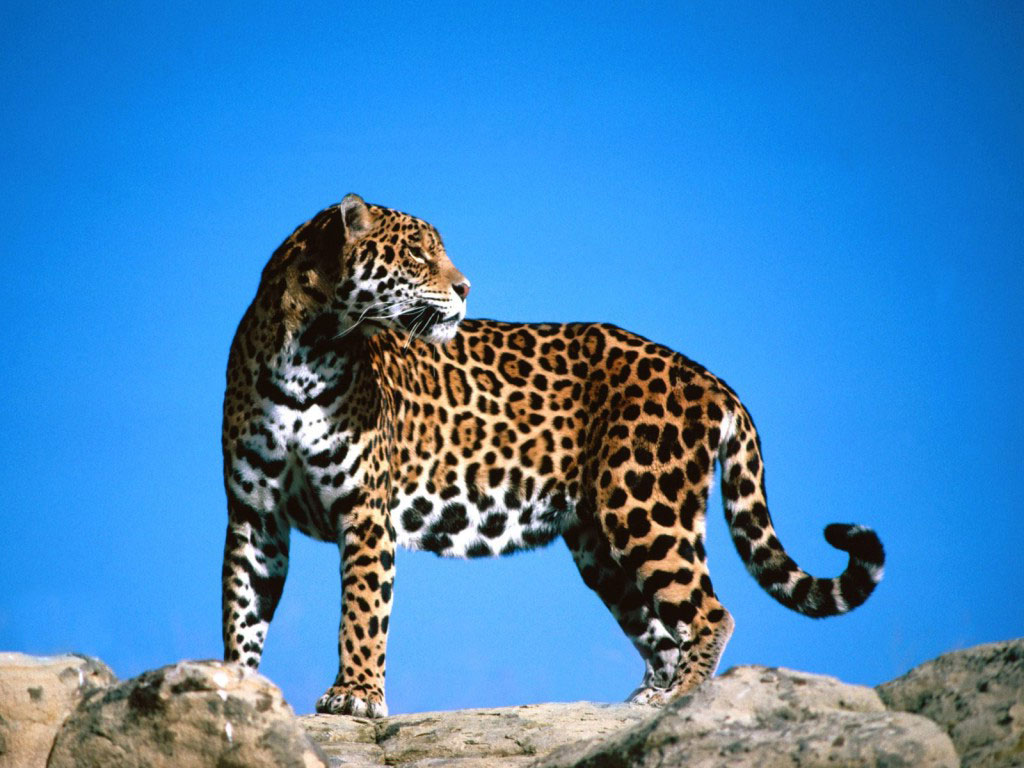
Image courtesy of: http://animalswalls.blogspot.com
(As was hinted at previously, the jaguar shares its biological grouping, Panthera, with three other big cats: lions (Panthera leo: African and Panthera leo persica: Asian), tigers (Panthera tigris: altaica [Siberian or Amur]; tigris [Bengal or Indian]; corbetti [Indochinese]; amoyensis [South China]; sumatrae [Sumatran]; jacksoni [Malayan]) and leopards (Panthera pardus). And these are the only big cats that can vocalize (roar); they do so for a few reasons, but mainly to frighten off other animals and to defend their territories. Of all the carnivores, the big cats possess the best three-dimensional vision which assists them in gauging distances when jumping.) (Source: Zoological Society of San Diego, sandiegozoo.org, 2011)


Image above is courtesy of: http://superpunch.blogspot.com

Image above is courtesy of: http://www.telegraph.co.uk
Compounding the fur trade problem and contributing to its declining numbers, is the fact of the jaguar's shrinking habitat. With less and less wild prey available to them, jaguars have naturally begun feeding on livestock (horses, cattle, sheep, et cetera), which puts them in direct competition with farmers who are eager to protect their investments and livelihoods. Ranchers, who may view jaguars as nothing more than problematic pests, often respond to the culling of their livestock by trapping and poisoning jaguars. Other threats to their homelands involve deforestation due to logging, mining, and expanding farm lands which encroach upon and fragment their habitats, leaving the animals with fewer food options and even fewer mates. (Sources: Zoological Society of San Diego, sandiegozoo.org, 2011; arkive.org, 2011)

Image above is courtesy of: http://animals.nationalgeographic.com

Image above is courtesy of: http://animalswalls.blogspot.com
Unlike most other cats, jaguars do not avoid water - indeed, they love and thrive in it. In fact, along with its cousin the tiger, the jaguar is the only other cat who excels at swimming. It is an invaluable skill at which jaguars are proficient: they happily wade through the many creeks, rivers and lakes that traipse, trickle, and meander through their various habitats - these include deciduous forests; lush rainforests; swamps; the flat, fertile pampas grasslands of South America; and mountain scrub areas - in search of the necessary prey they provide in the form of fish, turtles, or caimans — small, highly adaptable alligator-like animals of the crocodilian sub-species who are widely distributed throughout Central and South America. Resourceful predators, jaguars also stalk and kill larger animals such as deer, peccaries, capybaras, and tapirs. As well, they have been known to sometimes climb trees in order to ambush unsuspecting prey, pouncing upon and killing their victims with one powerful, crushing bite to the skull. The jaguar's reputation for being a formidable hunter is well-deserved. (Sources: Living Edens: Temple of the Tigers, pbs.org, 2001; crocodilian.com, 2011; nationalgeographic.com, 2011; nhptv.org, 2011)

Image above is courtesy of: http://www.animalpicturesarchive.com

Image above is courtesy of: http://www.fsz.estranky.cz/
With a lifespan estimated to be anywhere between fifteen and twenty years, jaguars are solitary animals who live and hunt alone (except during the breeding season, when males and females come together to mate and reproduce), defining their territories of many square miles - the male's home-range is between nineteen to fifty-three square miles; the female's home-range is between ten to thirty-seven square miles - by marking with their waste or by clawing trees. (A male jaguar may share his territory with several females but will aggressively protect his home-range from other males in order to ensure that any females in his territory mate only with him.) (Sources: nhptv.org, 2011; animal.discovery.com, 2011)

A jaguar mother and her one-week-old cub ~ National Zoo in Managua, Nicaragua
(Photograph by Esteban Felix)
Image courtesy of: http://www.theatlantic.com
Jaguars are able to mate year-round. Approximately one-hundred days after mating (gestation is primarily from ninety to one-hundred-and-ten days), females have litters of one to four cubs who are blind and helpless at birth and have fluffy, spotted fur. The mother stays with her young and defends them fiercely from any animal that may approach — even their own father. Young jaguar cubs learn to hunt and hone their survival skills by living with their mothers for about two years or more and begin hunting when they are six months old. (Sources: nationalgeographic.com, 2011; nhptv.org, 2011; animal.discovery.com, 2011)

Image above is courtesy of: http://animal.discovery.com
 Image above is courtesy of: http://tomclarkblog.blogspot.com
Two years ago, the only known wild jaguar in the United States was captured in a trap and euthanized by Arizona Wildlife authorities. The death of this big cat, named 'Macho-B,' triggered a federal investigation that found violations of the procedures that are meant to protect endangered species.
Video & source courtesy of: Assignment Earth ~ (Vimeo)


Video courtesy of: Woodland Park Zoo
Video courtesy of: BBC Earth
(Both videos are courtesy of youtube.com)

“In the jungles of Central America, jaguars are regarded as mystical and dangerous. According to local legend, indigenous people turn into jaguars when they enter the jungle, and then shake off their spots when they return to the village.”
~ Elisabeth Rosenthal
 Image courtesy of: http://animalswalls.blogspot.com

Habitat fragmentation and degradation; direct hunting by people, particularly sportsmen or ranchers; and lack of natural prey due to over-hunting by humans and which, in turn, compels jaguars to prey on domestic animals - thereby forcing the predators into an endless cycle of confrontational encounters with humans - these are the main threats and challenges facing the jaguar's survival. The relationship between jaguar and man is an uneasy and tense. That tension and mistrust between animal and humans is manifested in the jaguar's reputation for being "man-eaters." Numerous stories abound of men being followed for miles through the forest by solitary jaguars; being highly territorial animals (are not people also territorial in the extreme?), such stories may not necessarily mean that the jaguars are stalking the men as 'prey' - although that is precisely what people interpret such behaviour to be - but may, in fact, suggest that the jaguars are merely escorting the men off of their territory. Remarkably, there are also stories from the Amazonian Indians that tell of jaguars emerging from the forest to play with village children. (Sources: indiantiger.org, 2009; panthera.org, 2011)
Two years ago, the only known wild jaguar in the United States was captured in a trap and euthanized by Arizona Wildlife authorities. The death of this big cat, named 'Macho-B,' triggered a federal investigation that found violations of the procedures that are meant to protect endangered species.
Video & source courtesy of: Assignment Earth ~ (Vimeo)
So what is to be done? The key to the jaguar's survival - and even to thrive - is education and understanding; they are paramount. It is essential to understand not only the existing dangers encountered by the cats' habitats, but also the effect human populations and growth are having on those very same habitats, and that jaguars kill livestock out of desperation and survival. It is also essential to educate ourselves about the animals: where they live; how extensive their territories are; how they spend their days; and how they raise their offspring. Researchers are using camera-traps, which take photos when a large animal crosses in front of the camera's lens, and placing radio collars on some jaguars to help locate their whereabouts and track their daily movements. Some institutions and zoos, such as the San Diego Zoo, are working with Latin American scientists to study, monitor, and protect jaguars. It is imperative to assist ranchers develop programs that teaches them to avoid problems with the cats and avoid resorting to a shot-gun as a means to a solution. (Source: Zoological Society of San Diego, sandiegozoo.org, 2011)
Clearly, unconventional and innovative solutions are also needed. In Las Lomas, Costa Rica, for instance, a farm may sit in the middle of a piece of land that has been designated as a “jaguar corridor” — a protected pathway that allows these nocturnal animals to safely traverse populated areas of human civilization. As Elisabeth Rosenthal wrote in an article for The New York Times (May 11, 2010) entitled, To Help Jaguars Survive, Ease Their Commute, “These [jaguar] pathways represent an important shift in conservation strategy. Like many other nations, Costa Rica has traditionally tried to protect large mammal species like jaguars by creating sanctuaries — buying up land and giving threatened animals a home where they can safely eat, fight and breed to eternity.”
“But in the past decade or so, scientists have realized that connecting corridors are needed because many species rely for survival on the migration of a few animals from one region to another, to intermix gene pools and to repopulate areas devastated by natural disasters or disease. Placing animals in isolated preserves, studies have found, decreases diversity and risks dulling down a species — like preventing New Yorkers and Californians from getting together to procreate. ...critical migration routes were especially vulnerable in rapidly developing countries, where new roads, shopping malls, dams, playgrounds and subdivisions could spring up overnight, blocking the animals’ passage. To correct this oversight, Costa Rica and other countries have begun identifying and protecting corridors for jaguars and other large mammals, like tigers, snow leopards and pandas.”

“Most of the corridors are not obviously demarcated pathways, but virtual trails, 'protected' in the sense that builders and planners are not permitted to introduce obstacles to the animals’ movements through the area.”
“The idea is not to stop building entirely, but to adjust development so that animals can move through landscapes that humans also occupy. A tall fence surrounding a shopping mall may be forbidden, for example, or a two-lane road may have to be substituted for a proposed four-lane highway. Local residents must also be persuaded not to shoot wild intruders or otherwise drive them away when they are in transit, a shift in thinking that is already taking root here.” (Source & citation: Rosenthal, E., To Help Jaguars Survive, Ease Their Commute, nytimes.com, May 11, 2010)
A “shift in thinking” is exactly what is required: a paradigm shift in attitudes, perceptions, and novel methods of conservation. An equilibrium between wildlife, people, and their sources of income - farmlands and pasturelands - needs to exist if jaguars are to successfully survive (and flourish) through the Twenty-first Century and beyond.
Video courtesy of: http://www.nytimes.com
Clearly, unconventional and innovative solutions are also needed. In Las Lomas, Costa Rica, for instance, a farm may sit in the middle of a piece of land that has been designated as a “jaguar corridor” — a protected pathway that allows these nocturnal animals to safely traverse populated areas of human civilization. As Elisabeth Rosenthal wrote in an article for The New York Times (May 11, 2010) entitled, To Help Jaguars Survive, Ease Their Commute, “These [jaguar] pathways represent an important shift in conservation strategy. Like many other nations, Costa Rica has traditionally tried to protect large mammal species like jaguars by creating sanctuaries — buying up land and giving threatened animals a home where they can safely eat, fight and breed to eternity.”
“But in the past decade or so, scientists have realized that connecting corridors are needed because many species rely for survival on the migration of a few animals from one region to another, to intermix gene pools and to repopulate areas devastated by natural disasters or disease. Placing animals in isolated preserves, studies have found, decreases diversity and risks dulling down a species — like preventing New Yorkers and Californians from getting together to procreate. ...critical migration routes were especially vulnerable in rapidly developing countries, where new roads, shopping malls, dams, playgrounds and subdivisions could spring up overnight, blocking the animals’ passage. To correct this oversight, Costa Rica and other countries have begun identifying and protecting corridors for jaguars and other large mammals, like tigers, snow leopards and pandas.”

Image courtesy of: http://www.thebigcats.com/
“The idea is not to stop building entirely, but to adjust development so that animals can move through landscapes that humans also occupy. A tall fence surrounding a shopping mall may be forbidden, for example, or a two-lane road may have to be substituted for a proposed four-lane highway. Local residents must also be persuaded not to shoot wild intruders or otherwise drive them away when they are in transit, a shift in thinking that is already taking root here.” (Source & citation: Rosenthal, E., To Help Jaguars Survive, Ease Their Commute, nytimes.com, May 11, 2010)
A “shift in thinking” is exactly what is required: a paradigm shift in attitudes, perceptions, and novel methods of conservation. An equilibrium between wildlife, people, and their sources of income - farmlands and pasturelands - needs to exist if jaguars are to successfully survive (and flourish) through the Twenty-first Century and beyond.

A jaguar in the Pantanal, Brazil, the world’s largest wetland
(Photograph by Steve Winter/Panthera)
Image courtesy of: http://www.nytimes.com
Video courtesy of: Woodland Park Zoo
Video courtesy of: BBC Earth
(Both videos are courtesy of youtube.com)

“In the jungles of Central America, jaguars are regarded as mystical and dangerous. According to local legend, indigenous people turn into jaguars when they enter the jungle, and then shake off their spots when they return to the village.”
~ Elisabeth Rosenthal


Suggested sites & readings:
- ARKive
- Panthera
- Born Free
- The Big Cats
- Big Cat Rescue
- World Land Trust
- Defenders of Wildlife
- Wild Cat Conservation
- Big Cat Adoption Center
- Fauna & Flora International
- Wildlife Conservation Society
- Panther Ridge Conservation Center

Kingdom of Cats (1987), by National Wildlife Federation: National Wildlife Federation
Big Cats: Kingdom of Might (1996), by Tom Brakefield & Alan Shoemaker: Voyageur Press
The Carnivores (1997), by R. F. Ewer: Cornell University Press
Jaguars (1997), by E. Melanie Watt: Weigl Educational Publishers
The Big Cats And Their Fossil Relatives: An Illustrated Guide To Their Evolution And Natural History (1997), by Alan Turner & Mauricio Antón: Columbia University Press
Icons of Power: Feline Symbolism In The Americas (1998), by Nicholas J. Saunders: Routledge
Jaguar: One Man's Struggle To Establish The World's First Jaguar Preserve (2000), by Alan Rabinowitz: Island Press
Jaguars (2001), by Theresa Woods: Child's World
Borderland Jaguars (2001), by David Earl Brown & Carlos A. López González: University of Utah Press
Jaguars (2002), by Helen Frost: Capstone Press
Jungle of The Maya (2006), by Douglas Goodell, Jerry Barrack & Jim Wright: University of Texas Press
Jaguars (2008), by Sally M. Walker: Lerner Publications
The Jaguar's Shadow: Searching For A Myhtic Cat (2009), by Richard Mahler: Yale University Press